
Fintech app development is different from building almost any other kind of software, because users are not only trusting your design. They are trusting you with their money. A confusing sign-up, a hint of weak security, or a surprise fee can end the relationship in a single session, and winning that user back is far harder than keeping them.
That is why the strongest finance products are built on three foundations: smooth onboarding, serious security, and honest transparency. This guide walks through the must-have features in each area, explains why they matter, and shows how to prioritize them if you are planning a new product or improving an existing one.

Table of Contents
- Why Trust Is the Real Product
- Onboarding: Earning Trust in the First Five Minutes
- Security: Protecting Money and Data
- Transparency: Removing Surprises
- Supporting Features That Strengthen Trust
- Compliance Without Killing the Experience
- How LP Technologies Approaches Fintech App Development
- A Practical Launch Checklist
- Final Thoughts
Why Trust Is the Real Product?
In most apps, a bug is an annoyance. In fintech, a bug can mean a failed payment, a wrong balance, or exposed personal data. Users know this, so they judge finance apps more strictly than other software.
Successful fintech app development therefore treats trust as a feature set, not a marketing message. Every screen either builds confidence or erodes it. When you design with that mindset, three areas matter most:
- Onboarding, because it forms the first impression and the first friction.
- Security, because it protects the user and your business.
- Transparency, because it keeps the relationship honest over time.
Get these three right, and growth features become far easier to sell. Every decision in fintech app development should be tested against them.
Onboarding: Earning Trust in the First Five Minutes
Onboarding is where most finance apps lose users. People want access quickly, yet regulations require identity checks. The craft of fintech app development lies in meeting both needs without making anyone feel interrogated.
1. Progressive, mobile-first sign-up
Good fintech app development starts with a short first screen. Ask only for what you need at each step. Start with an email or phone number, then collect additional details when the user reaches a feature that requires them. Long forms at the start cause drop-off.
2. Smart identity verification (KYC)
Know Your Customer checks are mandatory for most financial products. Modern flows let users scan a government ID, take a selfie, and receive a decision in minutes. Useful touches include:
- Clear instructions on lighting and framing before the camera opens.
- Instant feedback if an image is unreadable.
- Status tracking so users know whether their verification is pending, approved, or needs action.
- A human fallback when automation fails.
3. Plain-language explanations
Whenever you ask for sensitive information, explain why. A single line such as “We verify your identity to protect your account and meet legal requirements” reduces anxiety noticeably. The Financial Action Task Force sets global standards on money laundering and customer due diligence, and referencing why checks exist helps users accept them.
4. A fast first win
After onboarding, let users do something valuable right away, such as linking an account, viewing a balance, or sending a small transfer. Early success builds momentum and confidence. Track the time between download and first successful action, because that single metric tells you a great deal about how well your onboarding really works.
Security: Protecting Money and Data
Security cannot be a final sprint before launch, and that is the first rule of fintech app development. It shapes architecture decisions from day one, and every high-quality fintech app development project plans for it early.
5. Layered authentication
Combine several methods so one weak point does not expose an account:
- Strong password rules or passwordless login.
- Biometrics such as fingerprint or face recognition.
- Multi-factor authentication for sign-in and for high-risk actions.
- Device binding, so new devices trigger extra verification.

6. Encryption and secure data handling
Data should be encrypted in transit and at rest. Sensitive values such as card numbers should be tokenized so your systems never store raw details unnecessarily. If your product handles card payments, follow the requirements of the PCI Security Standards Council.
7. Fraud detection and real-time alerts
Behavioral monitoring can flag unusual logins, unfamiliar devices, or abnormal transaction patterns. Pair detection with instant notifications so users can confirm or block activity within seconds. The ability to freeze a card or account with one tap is a feature users genuinely value.
8. Session and access controls
Automatic timeouts, secure session tokens, and role-based access protect both customers and your internal staff. Audit logs let you trace who did what, which is vital for investigations and compliance.
9. Regular testing and monitoring
Penetration tests, code reviews, dependency scans, and continuous monitoring catch problems before attackers do. Security is a process that continues after launch, so budget for it as an ongoing line item and not a one-time task. Schedule regular reviews, rotate secrets and keys, and rehearse your incident response plan so the team knows exactly what to do if something goes wrong.
Transparency: Removing Surprises
Transparency is where many finance apps quietly win or lose loyalty. Users forgive limitations, but they rarely forgive feeling tricked.
Show fees before the action. Display the total cost, including exchange rates and charges, before the user confirms a transfer or purchase. The Consumer Financial Protection Bureau regularly highlights how hidden or unclear fees harm consumers, and clear disclosure builds the opposite impression.
Give real-time status. Every payment should show whether it is pending, processing, completed, or failed, along with a reason and next step when something goes wrong.
Keep a clear history. Searchable transaction lists, downloadable statements, and categorized spending help users understand their own money.
Explain decisions. If a payment is declined or a loan application is rejected, say why in language people can understand. Silence feels like a black box, and a black box is the opposite of trust.
Make privacy controls visible. Let users see what data you collect, how you use it, and how to change permissions.
Offer reachable support. In-app chat, a help center, and clear escalation paths show that a real organization stands behind the product.
These behaviors might look like small details, but together they signal respect. In fintech app development, respect is a competitive advantage.
Supporting Features in Fintech App Development
Beyond the three foundations, a few capabilities round out a credible finance app:
- Notifications that matter. Alerts for deposits, bills, and security events, with user control over frequency.
- Accessibility. Support for screen readers, scalable text, and strong color contrast so more people can use the product.
- Reliable performance. Fast load times and graceful handling of poor connectivity. A frozen screen during a payment creates real anxiety.
- Multi-language and local payment support. Especially important in regions with diverse populations and varied payment preferences.
- Open integrations. Secure APIs that connect with banks, wallets, accounting tools, and identity providers.
- Education and guidance. Short explainers, budgeting insights, and in-context tips that help users feel capable.
Treat these as the second layer of fintech app development. Build the trust foundations first, then add them in order of customer value.
Compliance Without Killing the Experience
Regulation shapes every financial product, and the rules differ by country and by license type. Anti-money-laundering controls, data protection laws, payment standards, and reporting duties all influence fintech app development decisions.
The key is to design compliance into the product flow instead of bolting it on. Cost and timeline estimates for fintech app development should always include this work, because retrofitting controls later is slow and expensive. A few practical habits help:
- Involve legal and compliance experts during discovery, not after the build.
- Keep configurable rules so you can adapt when regulations change.
- Maintain complete audit trails for transactions and administrative actions.
- Document data flows so you can answer regulator and partner questions quickly.
When done well, compliance becomes invisible to the user and reassuring to partners, banks, and investors.
How LP Technologies Approaches Fintech App Development?
At LP Technologies, we build fintech software with the assumption that trust must be engineered, not promised. Our teams have worked on financial products where accuracy, security, and clarity were non-negotiable, and we bring that discipline to each new engagement.
Our approach to fintech app development includes:
- Discovery with risk in mind. We map user journeys, regulatory needs, and threat scenarios before we write code.
- Security by design. Authentication, encryption, and monitoring are planned into the architecture, not added later.
- Onboarding that converts. We prototype and test sign-up and KYC flows to reduce friction while meeting compliance requirements.
- Transparent product design. We design fee displays, statuses, and error messages to keep users informed at every step.
- Scalable engineering. Using modern stacks and cloud platforms, we build systems that handle growth and traffic spikes.
- Continuing partnership. We support releases, monitoring, and improvements after launch.
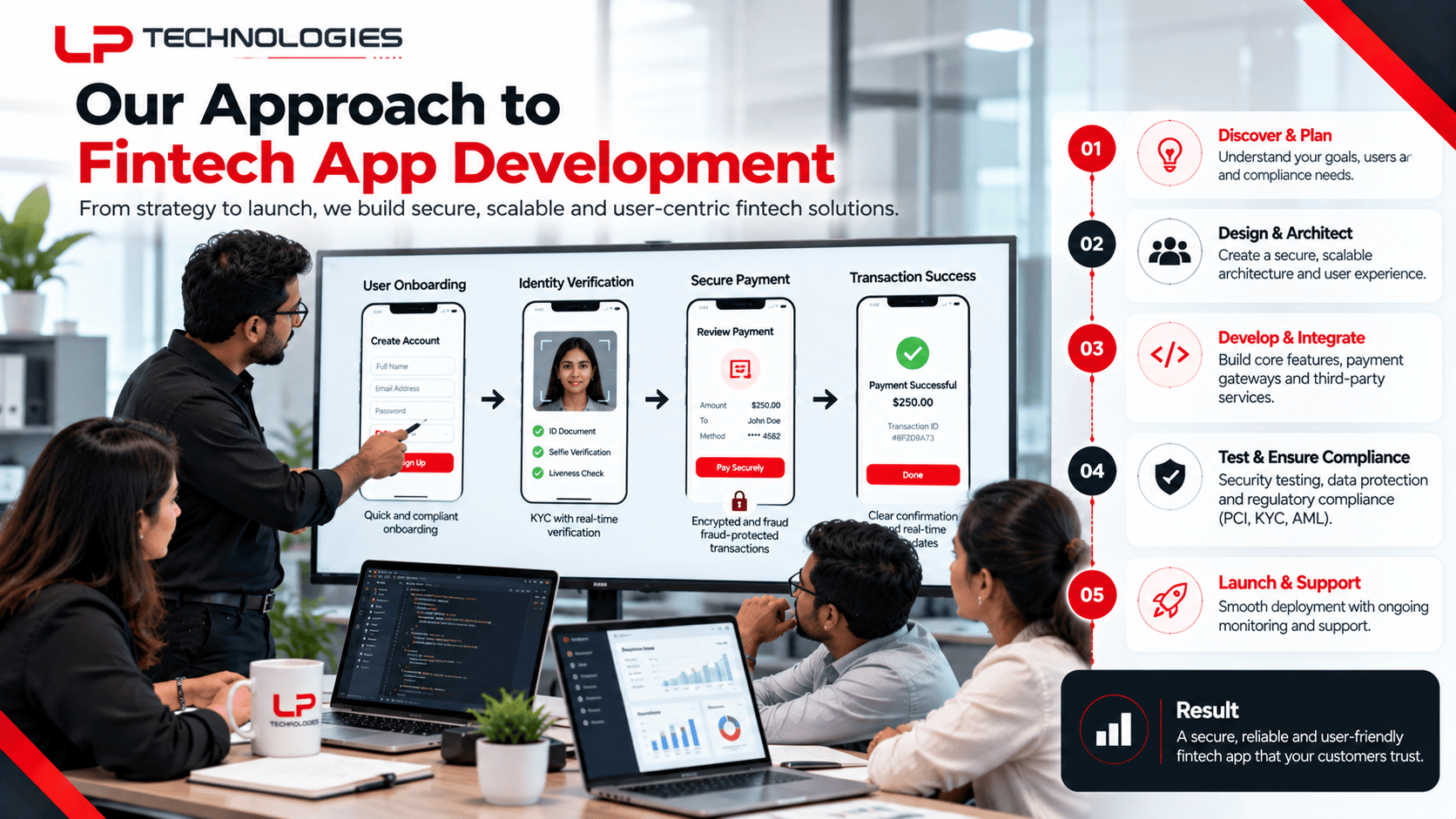
We deliver web and mobile products across many industries, and our work in finance draws on that broad engineering depth. You can explore our fintech software solutions, review our fintech case studies, or learn more about our mobile app development capabilities. As a strategic partner, we will challenge decisions that could weaken trust, even when a shortcut looks tempting.
A Practical Launch Checklist
Before you release your product, confirm that you can answer yes to these questions:
- Can a new user finish onboarding in minutes without confusion?
- Do we explain why every sensitive piece of data is requested?
- Is multi-factor authentication available and easy to use?
- Is sensitive data encrypted and tokenized wherever possible?
- Do users get instant alerts for important account activity?
- Are all fees and rates shown before confirmation?
- Does every transaction show a clear status and history?
- Can users reach a human when something goes wrong?
- Have we completed security testing and a compliance review?
Any “no” is a signal to fix the issue before launch, not after your first support crisis.
Final Thoughts
Great fintech app development is less about flashy features and more about earning confidence, one interaction at a time. Smooth onboarding gets users in the door. Layered security keeps them safe. Transparency keeps them loyal. When those three work together, every other feature you build becomes easier to adopt.
If you are planning a new finance product or want to strengthen an existing one, talk to our fintech team. We will help you design for trust from the first screen to the last transaction.

Leave a Reply